The Meal You Don't Remember Eating
One meal a day, eaten without a screen, from a plate, sitting down. What attention does to appetite and why memory of eating shapes what you eat next.
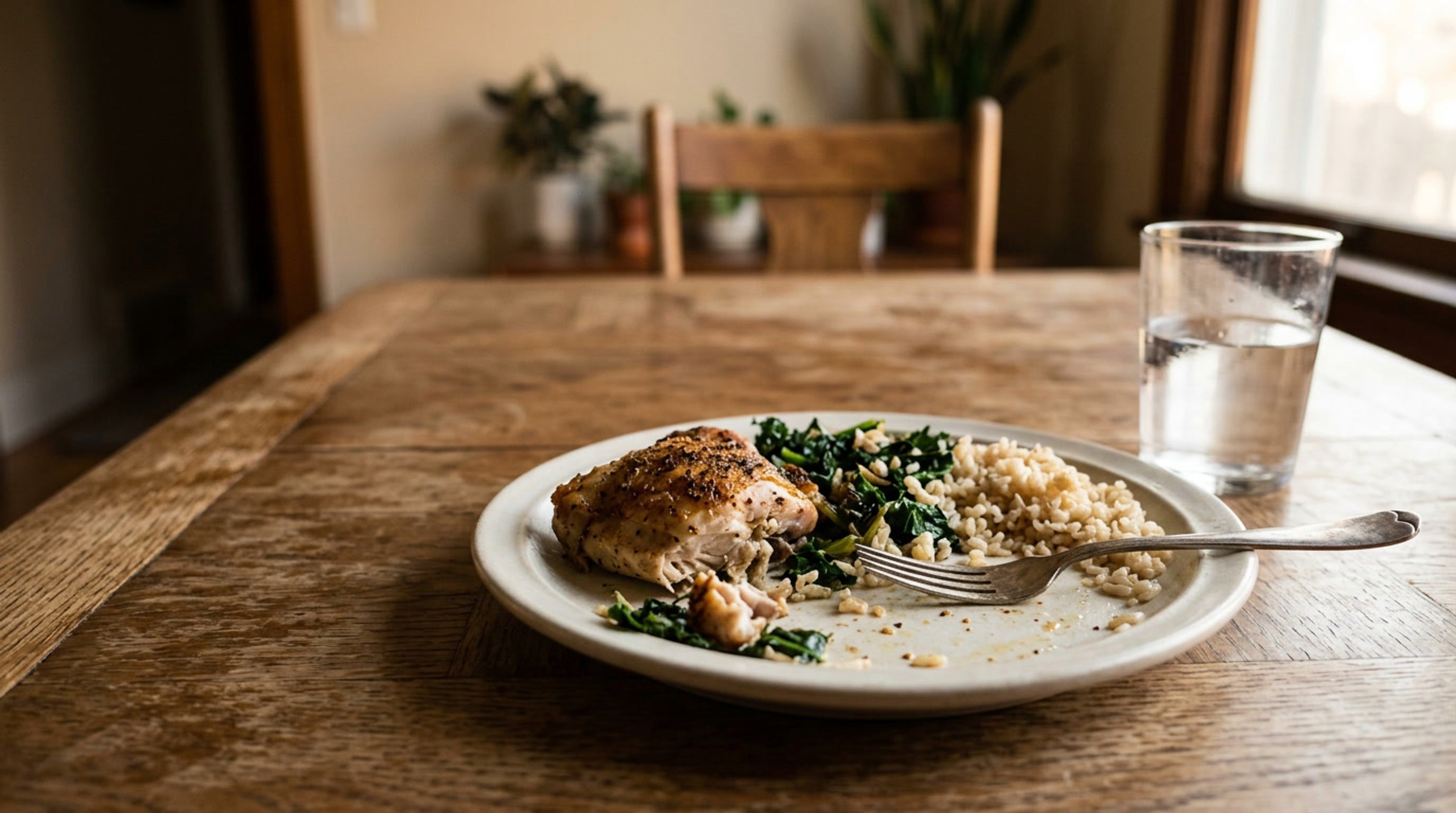
Describe your last meal. Not what it was you probably know that. Describe it: the temperature of the first bite, whether the bread was any good, the moment you stopped being hungry, what the last thing on the plate was.
Most people can name the food and recall almost nothing else. The meal happened. You were not there for it.
This is not a small thing dressed up as a large one. Eating is the activity we perform most reliably, three times a day, every day, for our entire lives and for a great many of us it has quietly become something that occurs beside the actual event of the moment, which is a screen. The food goes in. The attention is elsewhere. And then the plate is empty and twenty minutes have passed and you could not, under oath, tell anyone what happened.
Last month we looked at a four-minute pause you couldn't sit through. This month is the same problem wearing a different coat: an activity with a built-in pause that we have learned to fill.
The Practice
One meal a day, eaten without a screen, from a plate, sitting down.
That's the whole thing. Not a food. Not a rule about what's on the plate. A rule about where your attention is while it empties.
Choose the meal that's easiest to protect for most people that's breakfast or dinner, because lunch is where work lives. Put the phone in another room, not face-down on the table. Face-down still works; it just works on you.
Then eat, and pay attention to eating.
Why It Works: Two Mechanisms
You eat according to what you remember
This is the genuinely surprising part, and it's the reason the practice belongs in this column rather than in a recipe section.
Some of the most striking evidence about human appetite comes from studies of people with severe amnesia. When offered a second full lunch shortly after finishing a first one, they ate it. Offered a third, some ate that too. Their bodies had received the food. Their stomachs were full. What was missing was the memory of having eaten and without that memory, the meal effectively hadn't happened.
Most of us have intact memory systems, but attention is the gate that memory passes through. Eat while absorbed in a screen and you don't encode the meal properly. Later, some part of your system behaves as though it didn't occur and researchers have shown this in ordinary people, not just patients: prompting someone to recall their lunch in detail changes how much they eat in the afternoon.
The implication is unusual. Your relationship to food is not governed only by what your body received. It's governed by what you noticed.
Fullness arrives on a delay, and speed outruns it
The second mechanism is more mechanical. The signals that tell your brain the meal has landed stretch receptors, gut hormones, the slow arithmetic of digestion take on the order of twenty minutes to arrive with any authority. Meanwhile, the mouth and the hand are capable of clearing a plate in eight.
Distraction doesn't just remove attention. It removes the natural brakes: the pause between bites, the moment of setting the fork down, the small check-in of am I still hungry. Screens compress those out. You can finish an entire meal inside the gap before your body has finished forming an opinion about it.
Attention slows eating without requiring you to try to eat slowly which matters, because trying to eat slowly is exactly the kind of effortful, willpower-dependent instruction that fails by Thursday. Noticing your food is pleasant. Rationing your bites is not. Only one of those survives a month.
Both mechanisms rhyme with last month's steep. The friction is the feature. The structure does the work that discipline can't sustain.
What the Evidence Actually Says
Strong. Attentive eating is one of the better-supported findings in this whole territory. Reviews pooling dozens of experiments find that eating while distracted increases how much people eat during that meal, and more interestingly increases how much they eat later in the day. The effect on the later meal is the one that points at memory rather than at willpower.
Strong. The amnesia studies are old, small, and unrepeatable for obvious ethical reasons, but they're vivid and the finding has been extended in healthy participants through memory manipulation experiments. Memory of eating shapes subsequent appetite. This is real.
Reasonably supported. Slower eating pace is associated with lower intake within a meal and higher self-reported fullness. The mechanism is plausible and the association is consistent, though much of the literature is observational and pace is tangled up with other habits.
A stretch, and I'd avoid it. Anything framing this as a weight-management technique. The intake effects in these studies are modest and measured over hours, not months, and the moment you convert "pay attention to your food" into "use attention to eat less," you've turned a restorative practice into a monitoring task and monitoring tasks make eating worse, not better. That's not caution for its own sake; it's the difference between a practice that lasts and one that curdles.
The honest summary: attention changes your experience of eating, and your experience of eating turns out to matter more than we assumed. That's the claim. It's smaller than the wellness industry's version and considerably better supported.
The Protocol
One meal. One month. No additions.
The temptation here is enormous to also fix what's on the plate, to log it, to photograph it, to make it an occasion. Resist all of it. The practice is attention, and every addition competes with attention.
Choose the defensible meal. Pick the one that isn't already contested by other people's schedules. A practice that requires the household to cooperate is a negotiation, not a habit.
Move the phone out of the room. This is the only genuinely non-negotiable instruction. Face down on the table still occupies part of your attention, holding a low-grade readiness for the buzz. Distance is what removes it.
Use a plate and sit down. Standing at the counter is how we eat when the meal doesn't count. The plate is a small declaration that it does.
Notice three things. If "pay attention" feels too vague to act on, make it concrete: the first bite, the moment your hunger changes, and the last bite. Three checkpoints. Nothing to write down.
Let the silence be awkward for a week. It will be. Eating alone without a screen surfaces the same discomfort as the empty four minutes, for the same reason. It passes on roughly the same timeline.
What success looks like at thirty days: you can describe yesterday's meal not what it was, but what it was like. That's the measure. If you can, the attention landed. If you can't, the screen probably won.
What This Won't Do
It won't change what's on your plate, and it won't fix a food supply, a budget, or a schedule that constrains what you can cook. It isn't a weight tool, and I'd gently steer you away from using it as one if eating is already a place where you feel monitored or anxious, adding a layer of observation is the wrong prescription, and a conversation with someone qualified is a better one.
What it offers is narrower: one meal a day that you were actually present for. Over a month, that's thirty small returns to an activity you were performing anyway and had stopped attending.
The food was always going to arrive. This is only about whether you were there when it did.
The Monthly Measure runs once a month. Each issue takes one practice, examines what's actually underneath it, and gives you something to try.
From the Steep Shelf
A few tools, teas, and staples we use (or would use) to support the ideas in this article.
Some links on this page are affiliate links. If you buy something through them, we may earn a small commission at no extra cost to you. We only recommend products we have used or genuinely believe in.
Written by
Terra
Health writer focused on circadian biology, nervous system regulation, and sustainable performance for independent workers.
Continue reading
Paper Before the Prompt
A ten-minute page before the screen: a small, evidence-aware practice for finding your own position before asking a tool to think with you.

A Sunday Wind Down Ritual: Designing the Threshold into the Week
Transform Sunday night anxiety into a peaceful transition. Learn how a consistent wind down ritual helps your nervous system bridge the gap between weekend rest and Monday morning.

The Four Minutes You Can't Sit Through
The Monthly Measure runs once a month. Each issue takes one practice, examines what's actually underneath it, and gives you something to try.