The Four Minutes You Can't Sit Through
The Monthly Measure runs once a month. Each issue takes one practice, examines what's actually underneath it, and gives you something to try.
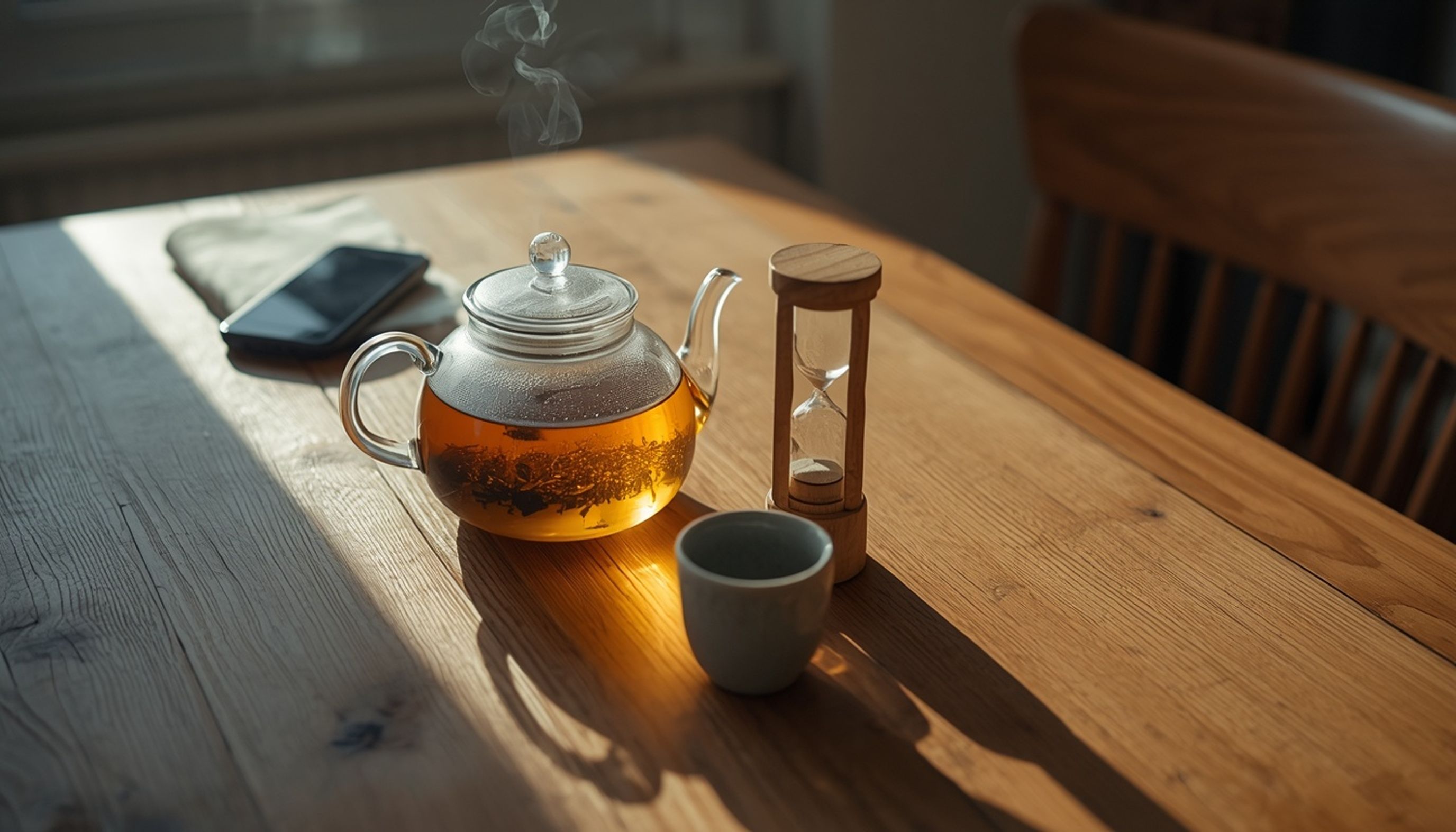
Try this before you read any further. Set a timer for four minutes, put your phone facedown, and do nothing until it goes off. No music. No window-shopping. No "I'll just check one thing."
Most people don't make it to ninety seconds.
That's the problem this issue is about… not stress, not burnout, not any of the large words we use to avoid naming the small thing. The small thing is this: somewhere in the last decade, most of us lost the ability to sit inside an unfilled four minutes without reaching for something. The loss happened gradually, and because every device we own is designed to make sure we never notice, almost nobody has tried to get it back on purpose.
There is a particular kind of quiet that arrives between pouring hot water over loose leaves and the first careful sip. It cannot be hurried. It cannot be optimized into a five-second pod. And that, increasingly, is exactly the point.
The Practice
Loose leaf tea, steeped properly, once a day.
Not a wellness philosophy; A procedure: Heat water to temperature, measure leaves into a vessel, pour, wait three to five minutes, remove the leaves, drink. Six steps. Ten minutes end to end, four of which you spend doing nothing.
The reason it belongs in this column, isn't the tea. It's the waiting. Loose leaf steeping is one of the last common household activities that has a mandatory pause built into its physics a pause you cannot shorten without visibly ruining the result. You can hurry almost anything else in your kitchen. You cannot hurry this.
That makes it a training device that doesn't feel like one.
Why It Works
The chemistry of a whole leaf
Loose leaf teas retain whole leaf compounds L-theanine, catechins, volatile aromatics that powdered or fannings based formats often degrade.
This isn't tea-snob mythology. it's surface area and structure. The dust and fannings inside most commercial tea bags are leaf fragments with far more exposed surface, which means faster oxidation on the shelf and a faster, harsher extraction in the cup. The delicate aromatic oils that give a jasmine green its perfume or a first-flush Darjeeling its muscatel edge are volatile by nature they dissipate when the leaf is broken, ground, and left in a paper pouch under warehouse lighting.
Whole leaves, by contrast, unfurl. Tea enthusiasts call it the agony of the leaves, though it looks more like a slow exhale: the twisted, dried leaf rehydrating, opening, releasing its compounds in sequence rather than all at once. A whole leaf gives you a beginning, a middle, and an end. Dust gives you a headline.
The compound most relevant here is L-theanine, an amino acid found in meaningful quantity almost nowhere else in the human diet. It's the reason tea's caffeine feels different from coffee's. Tea has less spike, less edge, and more of what researchers describe as calm alertness.
The behavior of a bounded wait
A ritual is a system small enough to keep, repeated often enough to matter.
That definition matters, because "ritual" has become a marketing word attached to skincare routines, supplement stacks, and $90 candles. Strip the branding away and a ritual is just this: a bounded sequence of actions, done deliberately, that returns more than it costs.
The steep scores unusually well on that math, and the reason is counterintuitive. The friction is the feature. You cannot rush the steep without ruining the cup, so the ritual enforces its own boundary. The kettle and the timer do the work that willpower usually fails at. Every other attempt you've made to sit still for four minutes required you to decide to keep sitting there, moment by moment, against a rising urge to do something. This one doesn't. The tea isn't ready. That's all.
This is why the practice survives contact with a real life, and why "just meditate for five minutes" so often doesn't. One relies on discipline you may not have. The other relies on water temperature.
What the Evidence Actually Says
Ritualized behavior before a stressful or demanding task measurably reduces anxiety. This has been replicated across a range of behavioral studies, and notably it holds even when participants know the ritual is arbitrary. What appears to be doing the work is the sense of a bounded, controllable sequence in a moment that otherwise feels uncontrolled. A morning steep is exactly that shape.
The strongest research on restoring depleted attention comes from environmental psychology specifically, studies on time spent in natural settings, where undemanding sensory input allows directed attention to recover. The findings there are solid. Applying them to a teacup is an extrapolation: watching leaves unfurl is plausibly the same category of low demand attention, but nobody has run that study. I'd rather tell you that than dress a hypothesis up as a finding.
The Protocol
Start with one cup, one variety, one moment. Resist the urge to stack it with journaling, podcasts, and inbox triage. The tea is the practice.
This bears repeating, because the modern instinct is to bundle. If we're going to sit still for four minutes, surely we should also be learning something, logging something, clearing something. But a practice that requires six supporting activities isn't a practice it's a production. Productions get cancelled the first week life gets complicated. Practices survive.
Week one through four:
Choose one tea and stay with it. Not forever just long enough to know it. A single-origin green, a straightforward oolong, or an herbal steep like tulsi or lemon balm if you'd rather begin without caffeine. Drinking the same tea daily is how you learn to taste what a shorter steep or hotter water does. Variety later; familiarity first.
Anchor it to something that already happens. The most durable rituals borrow stability from an existing one. After the kettle goes on for the household, before the first screen of the day, while the kitchen is still yours alone. Attach the steep to a moment that exists rather than inventing one.
Let the steep time be empty. Watch the leaves. Look out the window. Stand there doing visibly nothing. This will feel unproductive, which is the entire point you are not passing time, you are practicing the exact capacity you set out to rebuild. The discomfort of an unfilled four minutes fades faster than you'd expect.
Lower the bar for what counts. A rushed morning where you still measured leaves and waited for the water is a completed practice. Perfect conditions are not a requirement. Repetition is.
What success looks like at thirty days: not calm, not transformation. Just this the four-minute timer from the top of this piece stops feeling like an ordeal. That's the whole measure.
Finally,
What a daily steep offers is smaller and honest: a few minutes each morning or afternoon where you are audience to nothing, a modest chemical nudge toward calm attention, and the compounding effect of one kept promise to yourself, kept again tomorrow.
The pod machine will always be faster. The leaf was never competing on speed. It offers the one thing that arrives in the quiet between the pour and the first careful sip, and that cannot be manufactured any other way than slowly.
From the Steep Shelf
A few tools, teas, and staples we use (or would use) to support the ideas in this article.
Some links on this page are affiliate links. If you buy something through them, we may earn a small commission at no extra cost to you. We only recommend products we have used or genuinely believe in.
Written by
Terra
Health writer focused on circadian biology, nervous system regulation, and sustainable performance for independent workers.
Continue reading

Paper Before the Prompt
A ten-minute page before the screen: a small, evidence-aware practice for finding your own position before asking a tool to think with you.

A Sunday Wind Down Ritual: Designing the Threshold into the Week
Transform Sunday night anxiety into a peaceful transition. Learn how a consistent wind down ritual helps your nervous system bridge the gap between weekend rest and Monday morning.

The Meal You Don't Remember Eating
One meal a day, eaten without a screen, from a plate, sitting down. What attention does to appetite and why memory of eating shapes what you eat next.